

Dismissing on a positive alcohol test? Be extra careful.
Alcohol-related misconduct cases continue to present a difficult balancing exercise for employers. While zero-tolerance policies are common (particularly in safety-sensitive environments), the CCMA and Labour Court have consistently emphasised that discipline must still be measured against fairness, proportionality and evidence of actual impairment.
A recent matter, CIPLA Distribution Gateway (Pty) Ltd v Mwale & Others, again highlights this tension and the importance of aligning workplace policies with practical, defensible enforcement.
Key principle: It is not only about the test result
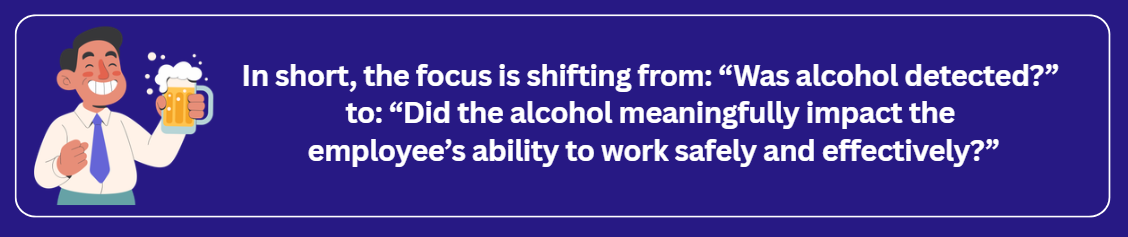
A recurring theme in recent arbitration and review decisions is that a positive alcohol test, on its own, is not always sufficient to justify dismissal.
Decision-makers increasingly consider:
• Whether the employer could demonstrate observable signs of impairment or incapacity
• Whether the employee’s conduct created a safety or operational risk
• Whether the employer applied proportionality in sanctioning the misconduct
Case insight: CIPLA Distribution Gateway (Pty) Ltd v Mwale & Others
In the case of CIPLA Distribution Gateway (Pty) Ltd v Mwale and Others (2026), a warehouse operator was dismissed after a breathalyser test returned a low alcohol reading of 0.019%. Following the test on June 26, 2023, the employee was immediately sent home. He was formally dismissed nearly two weeks later, on July 7, 2023, primarily due to the company’s strict “zero-tolerance” policy and the fact that he was already on a final written warning for a previous alcohol-related offense. The employee contested his dismissal, claiming he had consumed a Bioplus energy drink rather than alcohol.
The Cape Town Labour Court ultimately determined that the dismissal was substantively unfair and upheld the CCMA’s order to reinstate the employee. The court held that a “zero-tolerance” policy cannot be applied mechanically and that the company had failed to prove the reliability of its breathalyser test, specifically noting that the device’s calibration was not verified and that no confirmatory medical testing was offered to the employee. Furthermore, because the company’s own internal checklist indicated that the employee displayed no physical signs of impairment or safety risk, the court found the sanction of dismissal to be disproportionate and unreasonable.
The court emphasised the need for proof that an employee’s faculties were impaired to the extent that they could not perform complex or responsible tasks, particularly where dismissal is contemplated under a zero-tolerance policy.
This approach underscores that even where workplace rules are strict, enforcement must still be justified in context.
Practical contrast: Where stronger facts change the outcome
The outcome in CIPLA should not be read as limiting an employer’s ability to act decisively in all alcohol cases. Dismissal may well remain appropriate and defensible if the facts are materially different, for example:
• A significantly higher alcohol reading
• Prior disciplinary history or a final written warning for the same transgression
• Admission of substantial alcohol consumption prior to or during work
• Evidence of impairment or unsafe conduct
The key distinction is whether the employer can demonstrate both breach and impact, or at least a sufficiently serious breach in context of risk and policy.
Why observation evidence remains critical
One of the most important practical lessons from these cases is the continued value of observational evidence.
Even where breathalyser or other testing is used, employers strengthen their position significantly when they can show:
• Slurred speech, poor coordination, or disorientation
• Smell of alcohol on breath
• Erratic or unsafe behaviour
• Failure to perform routine tasks properly
• Timely documentation from supervisors or managers (notes made Notes made at the time of the observation)
These observations help bridge the gap between a numerical reading and actual impairment, something arbitrators increasingly scrutinise.
Zero-tolerance policies: useful, but not absolute
Zero-tolerance policies remain valuable, particularly in high-risk industries such as logistics, manufacturing, healthcare and security. However, they are not automatically dispositive.
Recent jurisprudence suggests the following risk areas for employers:
• Applying zero-tolerance without considering context and proportionality
• Relying solely on a test result without corroborating evidence
• Failing to distinguish between low-level presence and actual impairment
• Inconsistent application of discipline across employees
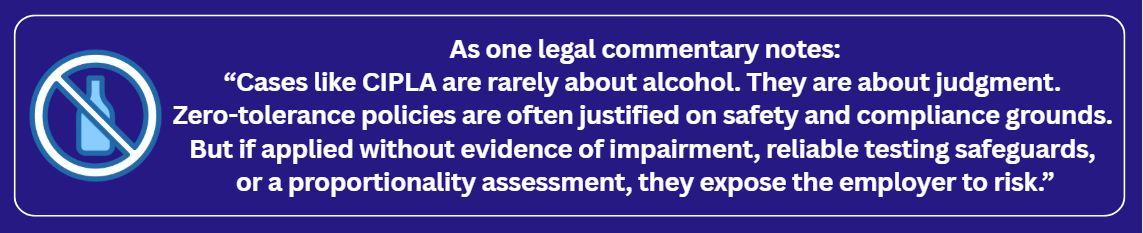
In practice, the decision to issue a final written warning rather than proceeding directly to dismissal, particularly for a first offence in lower-risk or non-safety-critical environments, can often be a safer and more defensible approach. Labour forums tend to scrutinise whether dismissal is a proportionate response, especially where there is no clear evidence of impairment, operational harm or safety risk. In such cases, a final written warning demonstrates that the employer treats alcohol-related misconduct seriously while still allowing a corrective opportunity, which can significantly strengthen the fairness of the disciplinary process. It also helps mitigate the risk of findings that the sanction was overly harsh or inconsistent, particularly where the employee’s role does not involve high-risk duties or where there is no prior disciplinary history.
Practical guidance for employers
To reduce legal and operational risk when dealing with alcohol-related misconduct, employers should ensure:
- Policies are clear and consistently applied
Zero-tolerance must be defined and operationalised consistently. - Testing is supported by observation
Breathalyser results should be paired with documented behavioural indicators where possible. - Supervisors are trained to record evidence properly
Timely and detailed notes often become decisive in disputes. - Sanctions are proportionate to the facts/risks
Prior warnings, role sensitivity and actual impairment should be considered. - Risk context is always considered
Higher standards may apply in safety-critical roles, but reasoning must still be recorded. - Always establish whether there is alcohol dependency
In one of Joubert and Associates’ articles, we do a deep dive into alcohol dependency. - Testing equipment is calibrated
Ensure that testing equipment is calibrated at all times and that calibration records are readily available.
Conclusion
Alcohol-related cases are rarely decided on policy alone. They are decided on evidence, context and fairness.
Employers who rely solely on zero-tolerance rules without documenting impairment or considering proportionality may find their decisions vulnerable at arbitration. Conversely, where strong testing evidence is supported by clear observations and contextual risk factors, disciplinary action remains well within defensible bounds.
The key is not to abandon strict policies, but to enforce them intelligently, consistently and with a clear evidentiary foundation.
Article written by Allen Stroebel
References:
https://www.saflii.org/za/cases/ZALCCT/2026/22.html
https://www.ensafrica.com/news/detail/11383/zero-tolerance-hangover-when-energy-drinks-le