

Alcohol and the Workplace – What You Should Know
As the festive season draws closer, employers are faced with the problem of unauthorised alcohol usage in the workplace on a regular basis. It can become very challenging for employers to manage these incidents when they are unsure about their obligations and appropriate measures to take to deal with employees effectively in this regard.
A policy is a good starting point to outline the employer’s position on the use of substances in the workplace, testing procedures and the measures followed to handle any such instances.
An Employer’s Obligation
An employer has an obligation towards employees to create and maintain a safe and healthy working environment[1]. This includes putting measures in place to ensure that employees are not under the influence of substances whilst performing their duties, which might potentially endanger colleagues and/or themselves.
When considering alcohol and the workplace, it is important to understand what the difference is between having alcohol “in your system” and being “under the influence” of alcohol.
-
Having alcohol in your system
- Definition: The substance (or its metabolic byproduct) is detectable via testing (e.g., blood, urine, saliva, hair).
- It is the presence of a substance in the body, that can linger even after the effects of the substance have worn off.
- Impairment: There may or may not be any active impairment to a person when a substance is detected in their system.
-
Being under the influence of alcohol
- Definition: An individual’s mental or physical faculties are impaired to such a degree that it affects their ability to perform tasks in a safe and competent manner (e.g., driving or operating machinery).
- It is an individual’s abilities that are actively impaired because of the consumption of alcohol.
- Impairment: This is typically proven through observable signs, including, but not limited to, slurred speech, delayed reactions, red eyes, being unsteady, etc.
In summary, the most important distinguishing factor is that “in your system” is an objective measure of the chemical presence and “under the influence” is a subjective observation of a functional impairment.
Appropriate Measures
An employer cannot take any disciplinary action against an employee for breaking a rule that does not exist. Therefore, it is pivotal that employers ensure that they have a proper policy in place. Alcohol policies are not a “one size fits all” and employers should take the time to consider a carefully tailored policy that is suitable for their unique working environment and activities.
Important factors to include in an alcohol policy:
- The rules regarding the consumption of alcohol on the company premises.
- The acceptable alcohol level / limits in the workplace.
- The applicable testing procedures.
- The measures in place to deal with instances of alcohol in the workplace.
Having a zero-tolerance policy might seem like the easiest solution to avoid any grey areas, but employers should be careful to implement such strict measures to the detriment of business operations, e.g., unnecessary high employee turnover.
In deciding on an appropriate alcohol limit, it is crucial to consider the type of work conducted by employees, the type of working environment and the occupational hazards involved, e.g., the acceptable alcohol limit for a truck driver should be much lower than the acceptable level for an office worker given the type of work and danger involved. It is also important to consider how an employee’s behaviour will impact the company’s image, e.g., retail staff who are client-facing can do more reputable damage than a financial clerk that does not regularly interact with clients.
It is trite that an employer may not interfere with an employee’s right to privacy, which includes the right to conduct themselves in a manner of their choosing outside of working hours. This may include indulging in alcoholic beverages. The policy of choice must accordingly be justifiable when measuring the rights of the employee against the operational requirements of the employer. Zero-tolerance policies should accordingly be reserved for extremely dangerous / high-risk work environments.
Testing Procedures
A breathalyser test has been widely accepted as an appropriate diagnostic device to measure the amount of alcohol present in the air that a person breathes out, which in turn can be used to determine an estimate of an individual’s Blood Alcohol Concentration (BAC). In South Africa, Breath Alcohol Concentration (BrAC) expressed as milligrams of alcohol per litre of breath (mg/L) is more commonly used than % BAC.
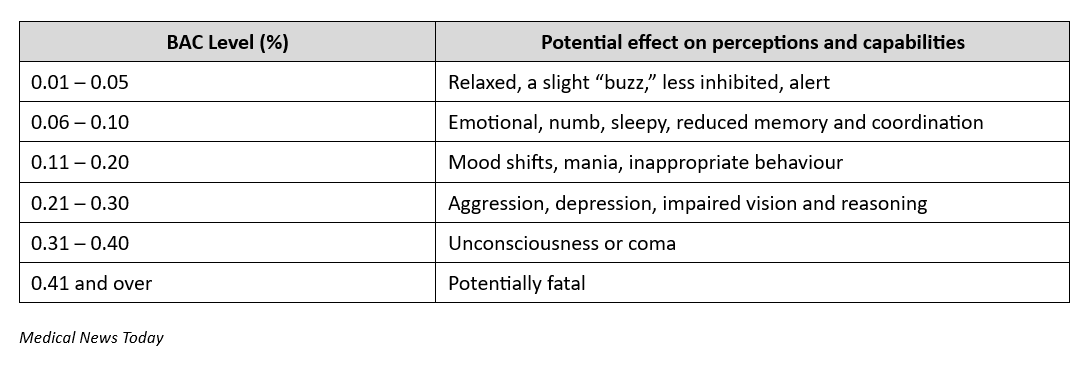
The chart below summarises various BAC levels and the potential effects that it can have on a person’s perceptions and capabilities:
The chart below shows the correlation between BAC level (%) and BrAC (mg/L):

A breathalyser test may be administered by the employer and/or another individual at the workplace who is properly trained in the use of the device. The employee’s written consent must be obtained prior to testing, and the employee has the right to have a representative present to witness the procedure. Similarly, the employer is entitled to have a witness present.
The employer must ensure that the breathalyser is correctly calibrated in the presence of both the employee and their representative. The policy should be specific about which level of intoxication is allowed. Additionally, a policy may also state that even if an employee’s test result is below the employer’s acceptable limit, disciplinary action may still be taken in accordance with the organisation’s alcohol policy, taking into consideration other circumstantial evidence, which may include:
- slurred speech
- bloodshot eyes
- the smell of alcohol on an employee’s breath
- being unsteady on their feet
- aggressive or confrontational behaviour
- unusually dishevelled appearance
It is essential that the policy clearly outlines how the employer will respond to and manage the outcomes of breathalyser tests.
Employers are encouraged to take special care in designing a policy that is fit for the organisation and for the purpose of maintaining a safe working environment.
[1] Occupational Health and Safety Act No. 85 of 1993
Article written by: Jané Theron
Sources:
https://www.cliffedekkerhofmeyr.com/practice-areas/downloads/Substance-Abuse-Guideline.pdf
https://labourguide.co.za/misconduct/alcohol-and-drugs-in-the-workplace
https://www.medicalnewstoday.com/articles/breathalyzer-test#types
https://labourguide.co.za/misconduct/alcoholism-and-the-workplace